

Patch Point
Yantra
Yantra
Impossible de charger la disponibilité du service de retrait
By Random Source
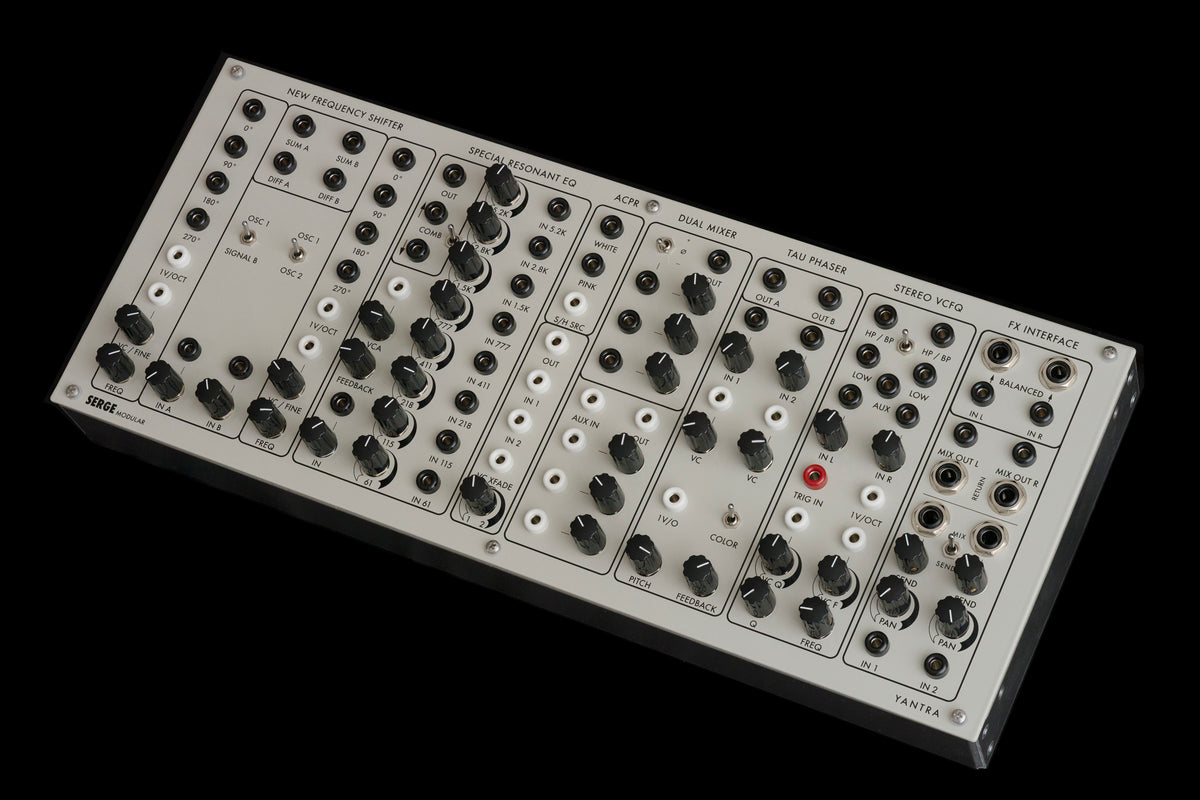
YANTRA is a comprehensive signal-processing panel designed to complement MANTRA II and TANTRA (or LA BESTIA III), while remaining a powerful standalone instrument. It combines the New Frequency Shifter, Special Resonant EQ, TAU Phaser, Stereo VCFQ, Serge noise sources, voltage-controlled crossfading, mixing, and a flexible FX Interface for external pedals and processors. With two sine-wave oscillators and extensive patching possibilities, YANTRA covers everything from spectral shaping, filtering, FM bliss and phasing to stereo processing, sound generation, and complex feedback patches.
- New Frequency Shifter / Quadrature Oscillators: two shifting channels for stereo or independent mono processing, from gentle beating to metallic textures. Two temperature-compensated sine oscillators also work as sound sources or exceptionally slow modulators, with four related phases available from each.
- Special Resonant EQ / ACPR / Noise: eight resonant bands, each with its own audio input, invite you to compose with different regions of the spectrum. Voltage-controlled band sums and feedback extend the EQ’s response. The linear crossfader blends audio or CV; the noise source supplies material for filtering and percussion.
- Dual Mixer / TAU Phaser: Serge’s updated and improved version of Jürgen Haible’s Tau “Pipe” Phaser brings an 18-pole sweep and a spacious pseudo-stereo output pair. The two mixers combine audio and control signals, blend processed sounds or set the amount of an external feedback return.
- Stereo VCFQ / FX Interface: two Variable Q Filters share frequency and resonance controls for coordinated stereo sweeps and percussive ringing. The effects interface brings external pedals into the patch or serves as a level-and-pan mixer. Independent balanced outputs connect the panel to your studio.
Connections between blocks are yours to choose: put the EQ before the phaser, shift a filtered sound, or use the mixers to bring parallel paths together. The order of processing becomes part of the composition.