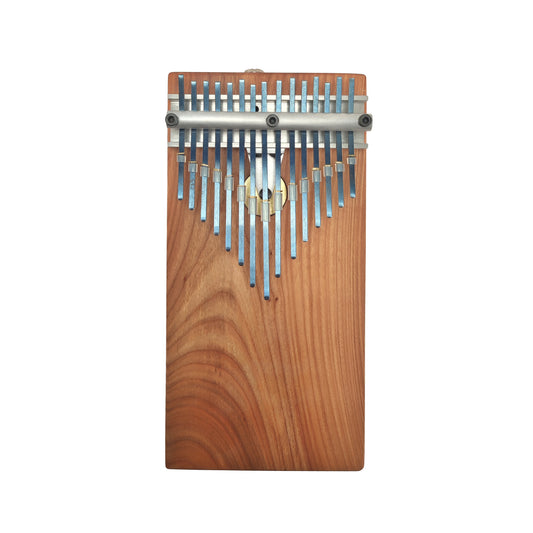
Brian Bamanya is often credited as the first person in Africa to build DIY modular synthesizer systems. It’s an inspiring story: he taught himself electronics and set out to build his own instruments. We first met Brian in person in May 2024. Residing in Uganda, he can sometimes be found at our shop or the woodshop in Berlin. He is currently developing an eKalimba and a microtonal sequencer for Bert Vermeulen’s Fénix III sequencer.
How long have you been working in instrument making, and what led you to it?
I would say about eight years. Could be ten also. The thing is there is not one day you can point to and say this is the day that I started. It's always been one thing leading to another. I was always interested in learning electronics and making stuff but deliberately using this knowledge to make music instruments must have started around ten years ago.
Which musicians, works, or moments have had the biggest influence on you as a designer, and where do you draw your inspiration from?
Inspiration comes from many sources and many people. I always saw the commercial synthesizers as inaccessible. And growing up in Uganda I had never seen anyone with say a Moog. Let alone any Eurorack modular. But then I landed on this YouTuber called Chris Beckstrom who made modular synths out of materials like plywood and very accessible electronic circuits. He was less focussed about the aesthetics of what his instruments looked like and I think he was more interested in having fun making music with his equipment. After watching him, I knew that I could do the same.
What is the biggest challenge in instrument making, and which challenge are you most proud of having overcome?
To make instruments, you have to learn multiple skills. To work with metal, wood, learn to program microcontrollers, printing etc. The good thing is that these skills are very useful for life beyond just making music instruments and I believe it makes you a more competent human being.
What influences you most in your process: control or chaos? Mystique or clarity? And how does that impact your outcome?
It has to be a mixture of both control and chaos. If you are designing things with power supplies, everything has to be controlled in order not to burn up the electronic circuits. On the other hand if part of the instrument just deals with the manipulation of sounds, there is a lot of space for chaos. Which is desirable because out of the chaos emerge good surprises.
When does an instrument feel finished?
I don’t know if an instrument is ever finished. That is why there is space for firmware updates and new versions of the instrument. But as the designer, there is a vision you start with, that first excited you about making something new. You keep on working until it becomes reality. Then I think you are done. But only for now!
What is the most important meal of the day, and what is your “go-to” dish?
If I am in Uganda, there's a popular snack called a Rolex. And no, it's not the Swiss watch. Its basically fried eggs rolled inside a chapati. If I have a tight schedule and I don't have much time for a decent meal, this is what I will pick up.


 Contact Us